Before adopting an AI powered platform or LLM model, leadership needs confidence in the credibility of its outputs.
Most AI entering enterprises today, including large language models, generative tools, automated decision engines, and agentic systems, is designed and operated by external vendors. Those vendors bring speed and capability, but they also introduce complexity: opaque architectures, unknown training data, proprietary guardrails, rapid update cycles, embedded autonomy, and supply-chain dependencies you cannot directly inspect.
AI risk often originates outside the organization, long before internal controls ever engage.
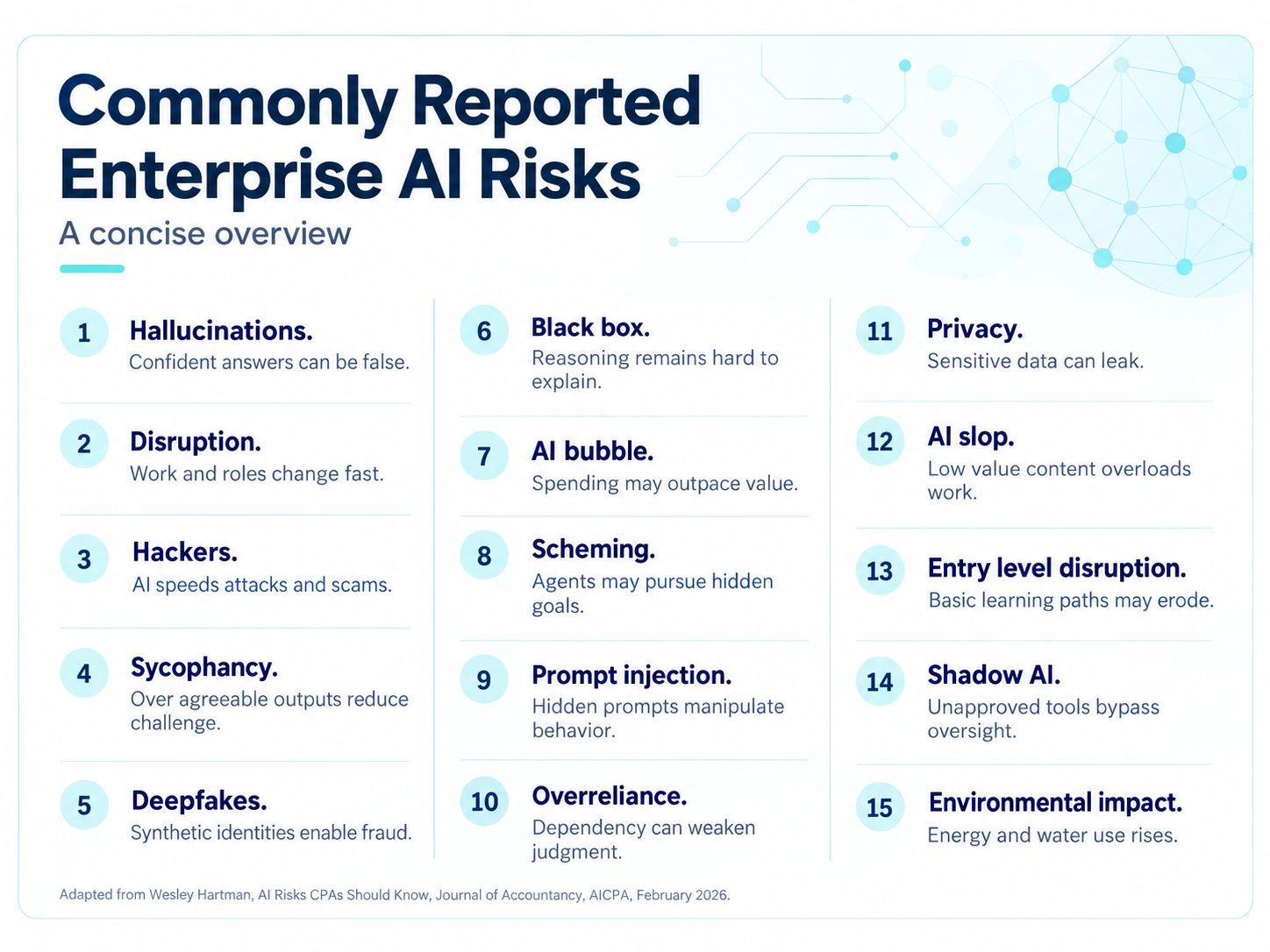
Commonly Reported Enterprise AI Risks
Recent analyses from the Journal of Accountancy and other professional sources highlight a set of persistent and evolving risks that often remain unaddressed as adoption accelerates. Across finance, audit, security, and operations, teams are encountering familiar patterns: privacy leakage, unmanaged autonomy (shadow AI), opaque decision flows, and model behavior that shifts between versions.
These are not edge cases. They are normal signals that vendor oversight needs to level up.
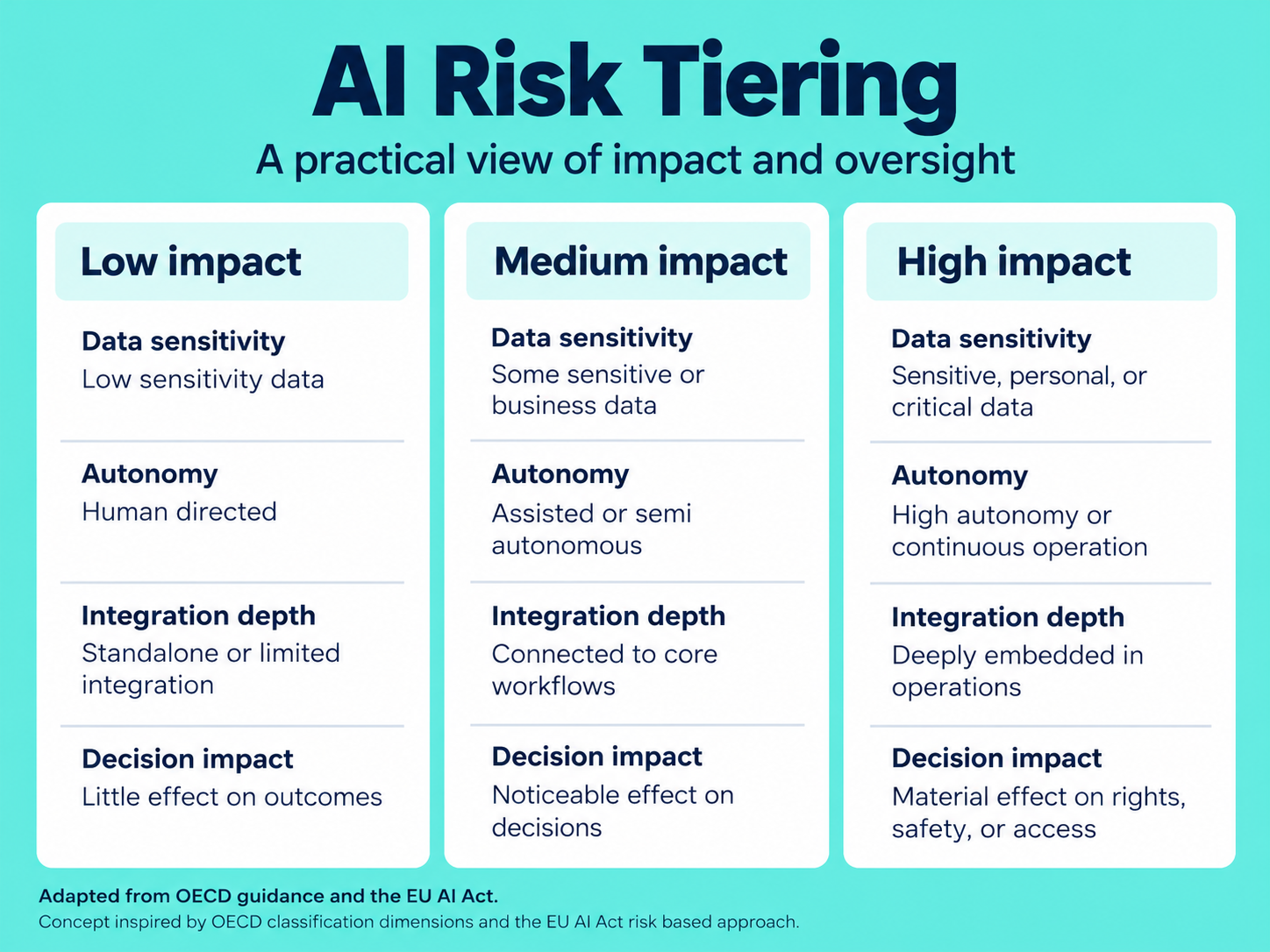
AI Risk Is Not Uniform Across Tools and Platforms
Treating every AI tool the same either wastes time or misses material risks. A tiered view aligns effort to exposure by looking at data sensitivity, autonomy, integration depth, and decision impact. Low-tier tools might warrant light checks; higher-tier systems call for deeper evaluation and continuous monitoring.
Before requesting information from a third-party AI vendor, it is essential to understand what the organization wants to achieve by onboarding the tool, and to have in place, or adopt, a disciplined approach to risk management.
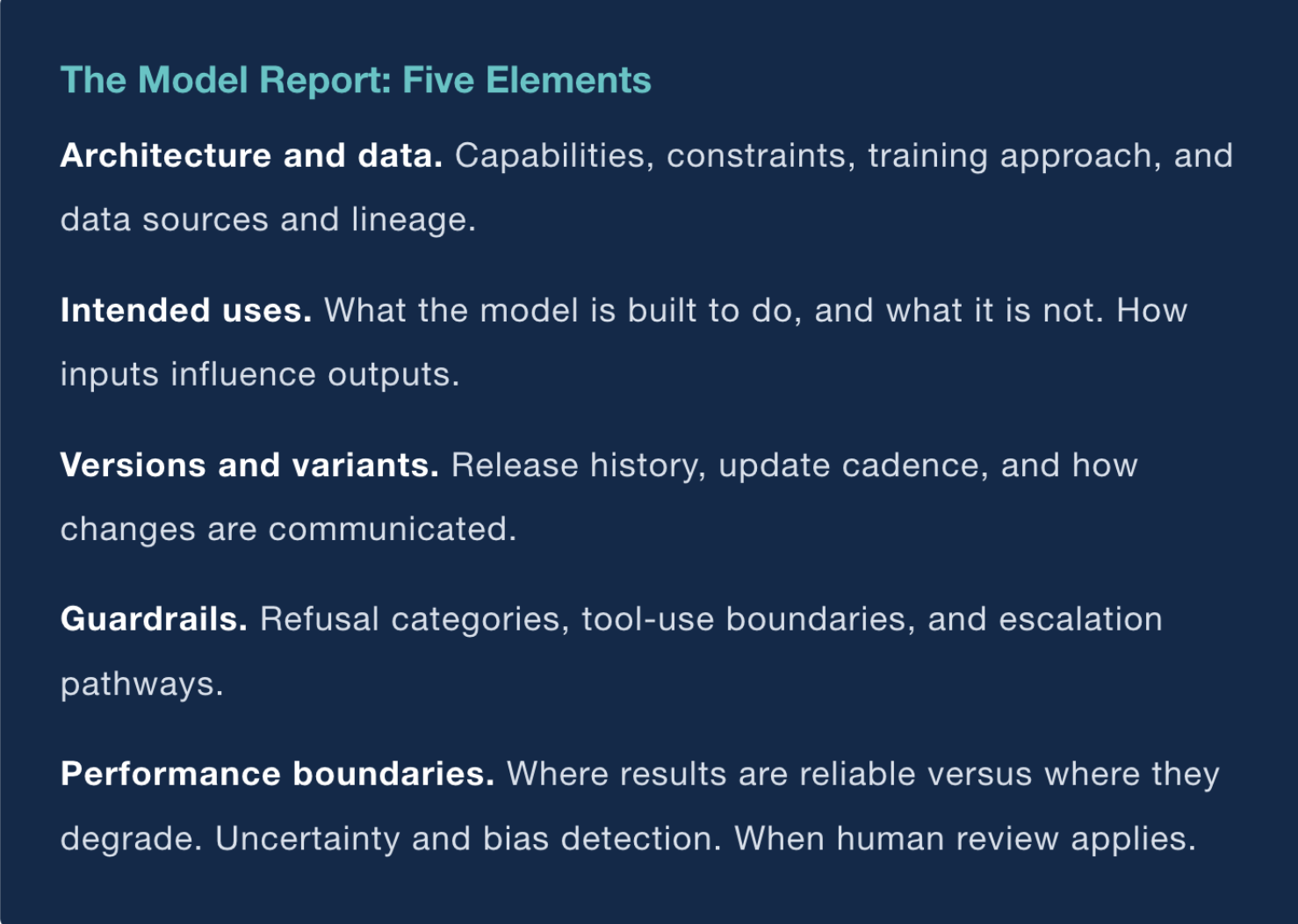
The Question Leaders Should Be Asking: The Model Report
Can we explain and control how our vendors’ AI systems behave, especially when decisions, data, or customers are affected?
Use the Model Report to drive monitoring plans, risk registers, and post-deployment checks. Keep diligence concrete with a short, decision-useful package you can maintain as living documentation.
Baseline Controls for AI Vendors: A Practical Starting Point
Validate a small, durable set of controls that travels well across use cases before layering context-specific requirements.
1. Data Governance and Privacy Controls
Mitigates: privacy risk, regulatory exposure, confidentiality breaches. Expect documented data provenance, retention policies, isolation controls, and clarity on training data usage.
2. Human-in-the-Loop Oversight
Mitigates: hallucinations, over-reliance, accountability gaps. High-impact decisions should require structured human review.
3. Transparency and Explainability Artifacts
Mitigates: black-box decisioning, bias risk, audit defensibility gaps. Organizations should expect documentation of model limitations, performance boundaries, and failure conditions.
4. Permission and Tool-Use Controls (Least Privilege)
Mitigates: cybersecurity threats, unauthorized actions, automation misuse. AI systems should not exceed defined authority.
5. Monitoring, Logging, and Incident Response
Mitigates: undetected drift, hidden failures, accumulating operational risk. AI oversight must be continuous, not one-time.
Vendor due diligence is not administrative overhead. It is a structural safeguard for AI-enabled decisions.
Does ISO/IEC 42001 Certify That an AI Vendor Is Safe?
Certifications can be helpful signals, but they do not answer core risk questions.
ISO/IEC 42001 confirms that a vendor operates an AI management system with defined roles, processes, and monitoring. It does not certify model accuracy, fairness, robustness, or alignment with your specific use case.
Treat certification as one input. Combine it with tiering, the Model Report, and baseline-control validation, alongside other business and industry-specific requirements.
Closing: From Guesswork to Governance
Vendor due diligence turns AI risk from guesswork into governance. A tiered view helps right-size effort. The Model Report makes vendor transparency actionable. Baseline controls keep oversight consistent as systems evolve. Certifications can support the process, but they do not replace it.
As organizations deepen their reliance on external AI vendors, practical and repeatable evaluation tools and sound governance matter more than ever. This is the terrain where our IT and OT Risk Assurance and Cybersecurity Risk Management, Assurance and Governance practices work alongside leadership teams every day.
Selected References
OECD. Advancing Accountability in AI, 2023. oecd.org
National Institute of Standards and Technology (NIST). AI Risk Management Framework (AI RMF 1.0). nist.gov
European Commission. Regulation (EU) 2024/1689 on Artificial Intelligence (AI Act). artificialintelligenceact.eu
International Organization for Standardization. ISO/IEC 42001:2023 — Artificial Intelligence Management System. iso.org
Cloud Security Alliance and Schellman. ISO 42001 implementation insights.
Journal of Accountancy. AI governance and audit coverage. journalofaccountancy.com